Mon-Fri 8:00 AM - 4:30 PM

A healthcare professional conducts a hearing test in a soundproof booth using equipment and headphones.

Comprehensive Hearing Assessments at Longmont Hearing and Tinnitus Center

Comprehensive Hearing Assessments at Longmont Hearing and Tinnitus Center

Unlocking Your Unique Hearing Profile

Unlocking Your Unique Hearing Profile

Experiencing difficulties with hearing can be more than just a minor inconvenience—it can impact your communication, relationships, and overall quality of life.

At Longmont Hearing and Tinnitus Center, your hearing health deserves a precise and personalized approach; no one hears the world in the same way, so your hearing care should be as unique as you are.

Our Comprehensive Hearing Assessment goes beyond basic tests to provide a detailed insight into your auditory and cognitive health, setting the foundation for optimal hearing solutions tailored just for you.

Experiencing difficulties with hearing can be more than just a minor inconvenience—it can impact your communication, relationships, and overall quality of life.

At Longmont Hearing and Tinnitus Center, your hearing health deserves a precise and personalized approach; no one hears the world in the same way, so your hearing care should be as unique as you are.

Our Comprehensive Hearing Assessment goes beyond basic tests to provide a detailed insight into your auditory and cognitive health, setting the foundation for optimal hearing solutions tailored just for you.

Two women are smiling, one is styling the hair of the other in a cozy indoor setting.

Why Comprehensive Matters

Many clinics offer standard hearing tests that only scratch the surface of your auditory capabilities. Our Comprehensive Hearing Assessment, however, dives deeper to explore the nuances of your hearing and ear-to-brain connection.


This thorough approach ensures that whether you are experiencing early signs of hearing loss, tinnitus, or other auditory difficulties, your unique hearing needs are met with professional assistance and recommendations. 

What Can You Expect for Your Hearing Assessment?
A Minute-by-Minute, Step-by-Step Rundown

Not all hearing assessments are created equal. You know as well as we do that there’s a big difference between a stay at the Ritz and a stay at a motel down the highway; the same is said for your hearing care.
Our hearing assessments are medical-grade diagnostic evaluations, not a “quick test” to check if you can hear the beep. When you partner with our team, you’ll leave our clinic knowing three things:

  1. What your ears and hearing system are doing

  2. What it means for your real-life experience

  3. What you can do next to get back to hearing the life you love most

These assessments typically take 60 minutes, sometimes longer depending on your unique circumstances and hearing concerns, as well as if we’re coordinating with physician care. Rest assured that we’re here to help you every step of the way.
BEFORE YOU ARRIVE

BEFORE YOU ARRIVE

Step 0 - Pre-Visit Preparation
(5-10 minutes of staff time)

After you book your appointment with us, we’ll review your intake paperwork, including your hearing health history, goals, symptoms, existing medications, concerns about tinnitus or dizziness, and family history.

Your hearing health expert will make notes of any red flag symptoms you’ve told us about, including sudden hearing challenges, one-sided hearing loss, ear pain or drainage, pulsatile tinnitus, asymmetrical hearing, or neurological symptoms.

From there, with your unique hearing needs in mind, we’ll start to plan your custom assessment. Everyone receives a comprehensive baseline to address hearing challenges, but we tailor your assessment based on your story.

Why It Matters:

A “standard” hearing test can miss specific nuances in your hearing health that are unique to you. Your symptoms determine what evaluations are included for your unique assessment as a whole.


Step 0 - Pre-Visit Preparation
(5-10 minutes of staff time)

After you book your appointment with us, we’ll review your intake paperwork, including your hearing health history, goals, symptoms, existing medications, concerns about tinnitus or dizziness, and family history.

Your hearing health expert will make notes of any red flag symptoms you’ve told us about, including sudden hearing challenges, one-sided hearing loss, ear pain or drainage, pulsatile tinnitus, asymmetrical hearing, or neurological symptoms.

From there, with your unique hearing needs in mind, we’ll start to plan your custom assessment. Everyone receives a comprehensive baseline to address hearing challenges, but we tailor your assessment based on your story.

Why It Matters:

A “standard” hearing test can miss specific nuances in your hearing health that are unique to you. Your symptoms determine what evaluations are included for your unique assessment as a whole.


A man and a woman are seated in an office, engaged in conversation, looking attentive and focused.

THE APPOINTMENT: Minute-by-Minute Expectations for Your Hearing Assessment

Step 1 - A Warm Welcome and Expectations Set
(0:00–0:05)

You’ll be warmly greeted at the door and checked in for your appointment, where we’ll confirm your primary concerns and explain how your hearing assessment will go.

After confirming your demographics, insurance benefits as applicable, and consent, you’ll be asked to identify your top listening goals, whether that be hearing amid background noise in busy restaurants, listening to your grandkids’ voices, feeling more focused in work meetings, or even just being able to hear the phone ring again.

Clear expectations are set, including time frames, interpretation of assessment tests, and potential next steps for your hearing health journey.

A lot of people don’t need “more volume” but rather more clarity in specific situations that matter to them. Your goals will guide interpretation and recommendations for your best hearing health.

Step 2 - An Interview with You and Your Ears
(0:05–0:15)

You could have the same hearing assessment results as someone we see the next day, but you and that person would have entirely different real-world needs for your hearing health.

By talking to you about what you need and your specific hearing concerns, our experts can start to decipher what difficulties could be stemming from and how to help alleviate your unique challenges.

Your hearing story will be translated into our clinical hypotheses for what could be causing your hearing challenges, including considerations of the type of hearing loss you’re dealing with, sound tolerance issues, cochlear vs. neural hearing challenges, and more.

We might ask you any of the following questions:

·       When did you first notice difficulty hearing? 

·       What situations are the hardest (distance, groups, soft talkers, cars, TV)? 

·       Have you had any ear pressure, pain, drainage, or infection history? 

·       What triggers are linked to your tinnitus? Has it impacted your sleep or stress levels?

·       Do you work in a busy environment where noise exposure is a concern (construction tools, concerts, hunting, military)?

·       Have you been having trouble with your balance (true spinning vertigo vs. lightheadedness)?

·       Do you have a family history of hearing loss?

·       Are there any medical factors we should consider that could affect hearing, like diabetes, cardiovascular disease, autoimmune disease, or chemo/ototoxic medications?

·       Do you find that you can hear, but you can’t understand? 

With these answers in mind, your hearing optimization journey and potential solutions are tailored to fit your best needs, no one else’s.

Step 2 - An Interview with You and Your Ears
(0:05–0:15)

You could have the same hearing assessment results as someone we see the next day, but you and that person would have entirely different real-world needs for your hearing health.

By talking to you about what you need and your specific hearing concerns, our experts can start to decipher what difficulties could be stemming from and how to help alleviate your unique challenges.

Your hearing story will be translated into our clinical hypotheses for what could be causing your hearing challenges, including considerations of the type of hearing loss you’re dealing with, sound tolerance issues, cochlear vs. neural hearing challenges, and more.

We might ask you any of the following questions:

·       When did you first notice difficulty hearing? 

·       What situations are the hardest (distance, groups, soft talkers, cars, TV)? 

·       Have you had any ear pressure, pain, drainage, or infection history? 

·       What triggers are linked to your tinnitus? Has it impacted your sleep or stress levels?

·       Do you work in a busy environment where noise exposure is a concern (construction tools, concerts, hunting, military)?

·       Have you been having trouble with your balance (true spinning vertigo vs. lightheadedness)?

·       Do you have a family history of hearing loss?

·       Are there any medical factors we should consider that could affect hearing, like diabetes, cardiovascular disease, autoimmune disease, or chemo/ototoxic medications?

·       Do you find that you can hear, but you can’t understand? 

With these answers in mind, your hearing optimization journey and potential solutions are tailored to fit your best needs, no one else’s.

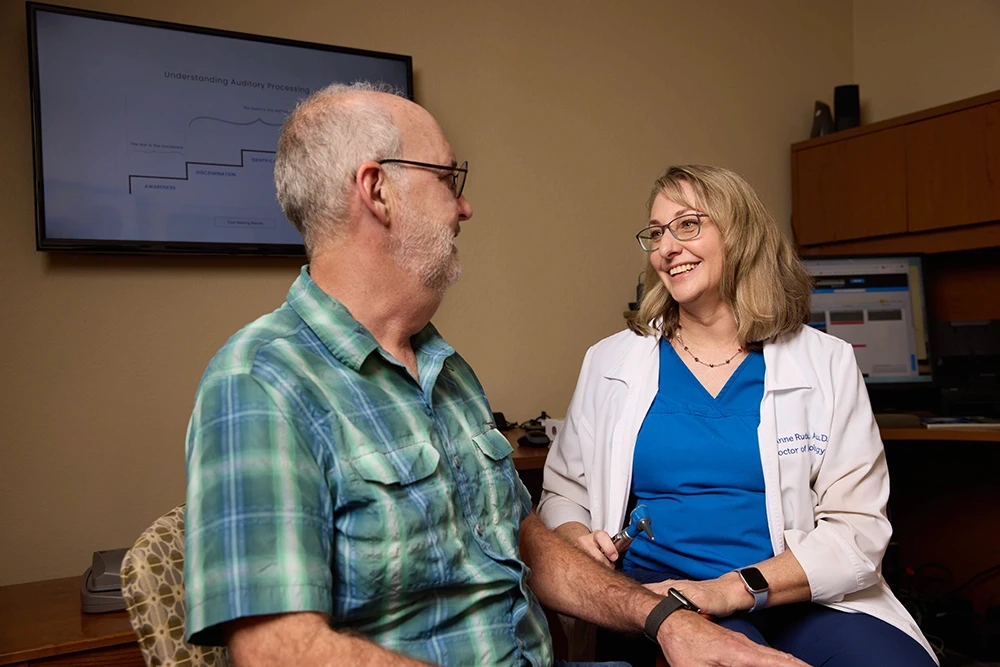
A woman laughs while gently listening to an older man's ear, both seated indoors.

Step 3 - Otoscopy and Ear Canal/Ear Drum Health Check
(0:15–0:16)

You can’t accurately assess hearing health if your ear canals are blocked! Ear health findings influence whether amplification is appropriate today and whether a medical referral is needed. 

Here, we’ll take a close look inside your ears and perform a visual inspection of your ear canals and tympanic membranes, looking for cerumen obstructions, signs of infection, perforated or scarred eardrums, and other anatomy considerations.

If wax is blocking your eardrum or will affect your hearing assessment, we’ll discuss safe removal options for your best hearing health and either manage it in-office or refer you for medical care, depending on your situation.

Step 4 - Tympanometry and Middle-Ear Function Testing
(0:16–0:20) 

Your eardrum mobility and middle-ear pressure are measured to identify middle-ear concerns like fluid, negative pressure, or stiffness that can often mimic or worsen hearing challenges.

If clinically indicated, we’ll also measure the reflex pathways of your auditory system, which will provide more information about the health of your middle ear and auditory pathway integrity.

This step depends on your clinical protocol and patient presentation, as the health of your middle ear can support referral decisions when needed.

Step 4 - Tympanometry and Middle-Ear Function Testing
(0:16–0:20) 

Your eardrum mobility and middle-ear pressure are measured to identify middle-ear concerns like fluid, negative pressure, or stiffness that can often mimic or worsen hearing challenges.

If clinically indicated, we’ll also measure the reflex pathways of your auditory system, which will provide more information about the health of your middle ear and auditory pathway integrity.

This step depends on your clinical protocol and patient presentation, as the health of your middle ear can support referral decisions when needed.

Step 5 - Inner-Ear Function Screening (0:20–0:23)

To assess the outer hair cell function in your cochlea, we’ll may perform distortion product otoacoustic emissions (DPOAEs).

This assessment is how we differentiate cochlear function issues, cross-check behavioral results, and provide necessary information when responses are inconsistent, which could lead to very early cochlear changes.

Step 6 - Comprehensive Behavioral Hearing Thresholds
(0:23-0:33)

Here, three assessments can be performed depending on your unique needs:

Air-conduction thresholds determine the softest levels you can detect across key pitches relevant to your situation, which builds the foundation for diagnosing the degree/configuration of hearing loss. 

Bone-conduction thresholds help determine what kind of hearing challenges you’re dealing with: conductive, sensorineural, or mixed. This is how we identify where the conflict is within your ear, whether it’s in the ear canal or deeper in the inner ear.

As needed, masking will be precisely performed to make sure that each ear is tested accurately and independently, as sometimes, one ear may be “helping” the other when hearing challenges are concentrated to one ear. This helps prevent inaccurate results and ensures a correct diagnosis for both ears, whether your hearing loss is asymmetrical or not. 

Step 6 - Comprehensive Behavioral Hearing Thresholds
(0:23-0:33)

Here, three assessments can be performed depending on your unique needs:

Air-conduction thresholds determine the softest levels you can detect across key pitches relevant to your situation, which builds the foundation for diagnosing the degree/configuration of hearing loss. 

Bone-conduction thresholds help determine what kind of hearing challenges you’re dealing with: conductive, sensorineural, or mixed. This is how we identify where the conflict is within your ear, whether it’s in the ear canal or deeper in the inner ear.

As needed, masking will be precisely performed to make sure that each ear is tested accurately and independently, as sometimes, one ear may be “helping” the other when hearing challenges are concentrated to one ear. This helps prevent inaccurate results and ensures a correct diagnosis for both ears, whether your hearing loss is asymmetrical or not. 

A person wearing headphones operates a sound booth, observing another individual through a soundproof window.

Step 7 - Speech Understanding Testing
(0:33–0:38)

This is often the most illuminating section of the full hearing assessment for many patients!

Speech reception threshold (SRT) testing helps confirm the softest levels at which you can repeat speech, which cross-checks your pure-tone audiometry results and validates test validity.

Word recognition testing measures the clarity of speech you can hear at appropriate loudness levels, helping explain the common concern of hearing but not understanding.

Speech-in-noise testing measures how your brain and ears perform when background noise is present, such as in busy restaurants, bars, and other gathering spaces where you want to hear the people with you, not the bustle of the crowds around you.

These assessments guide expectations for your hearing health and treatment planning. This is where many people struggle the most but also where premium solutions, accessories, and communication strategies can make a measurable difference. 
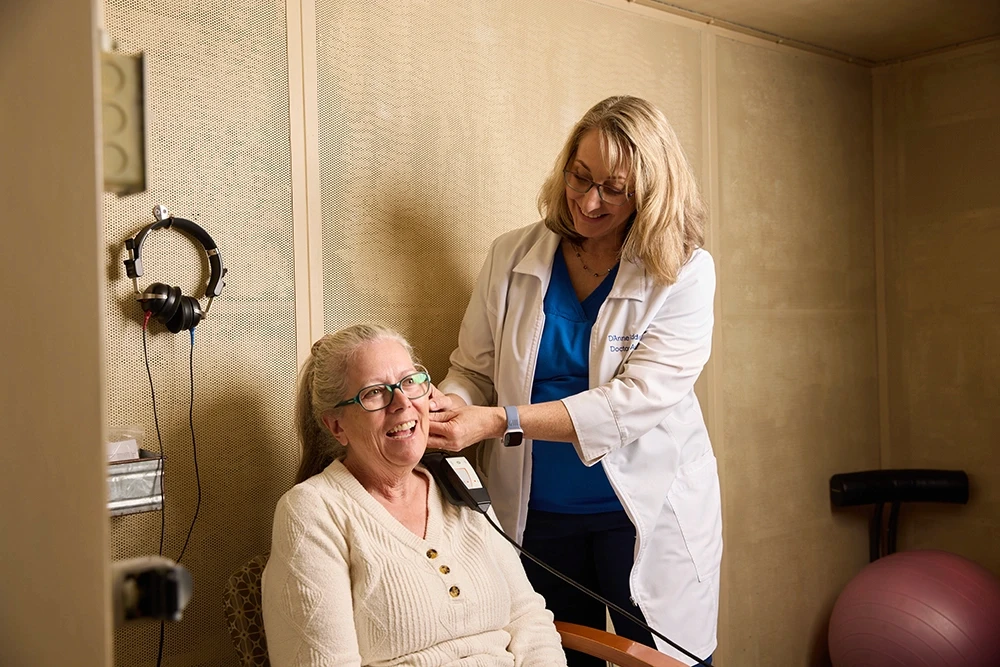
Step 8 - Real-World Listening
(0:38–0:43)

Speech-in-noise testing helps us to understand how you are doing in complex environments like restaurants and family gatherings. The results of the testing become the foundation to map your specific listening difficulties to likely solutions, including directionality (facing the speaker), noise reduction, remote microphones, and more, allowing for the most personalized hearing optimization plan possible.

To best understand the hearing aid settings you may need, as well as identifying sound sensitivity considerations, sound tolerance measures your comfort ranges with loud noise if you report sensitivity to sound or loudness discomfort.

With this assessment in mind, your results become a personalized listening blueprint, not just a graph. 

Step 8 - Real-World Listening
(0:38–0:43)

Speech-in-noise testing helps us to understand how you are doing in complex environments like restaurants and family gatherings. The results of the testing become the foundation to map your specific listening difficulties to likely solutions, including directionality (facing the speaker), noise reduction, remote microphones, and more, allowing for the most personalized hearing optimization plan possible.

To best understand the hearing aid settings you may need, as well as identifying sound sensitivity considerations, sound tolerance measures your comfort ranges with loud noise if you report sensitivity to sound or loudness discomfort.

With this assessment in mind, your results become a personalized listening blueprint, not just a graph. 

A healthcare professional administers care to an elderly patient in a warm, cozy setting.

Step 9 - From Data to Next Steps: Results Interpretation and Education
(0:43–0:50)

You can’t accurately assess hearing health if your ear canals are blocked! Ear health findings influence whether amplification is appropriate today and whether a medical referral is needed. 

Here, we’ll take a close look inside your ears and perform a visual inspection of your ear canals and tympanic membranes, looking for cerumen obstructions, signs of infection, perforated or scarred eardrums, and other anatomy considerations.

If wax is blocking your eardrum or will affect your hearing assessment, we’ll discuss safe removal options for your best hearing health and either manage it in-office or refer you for medical care, depending on your situation.
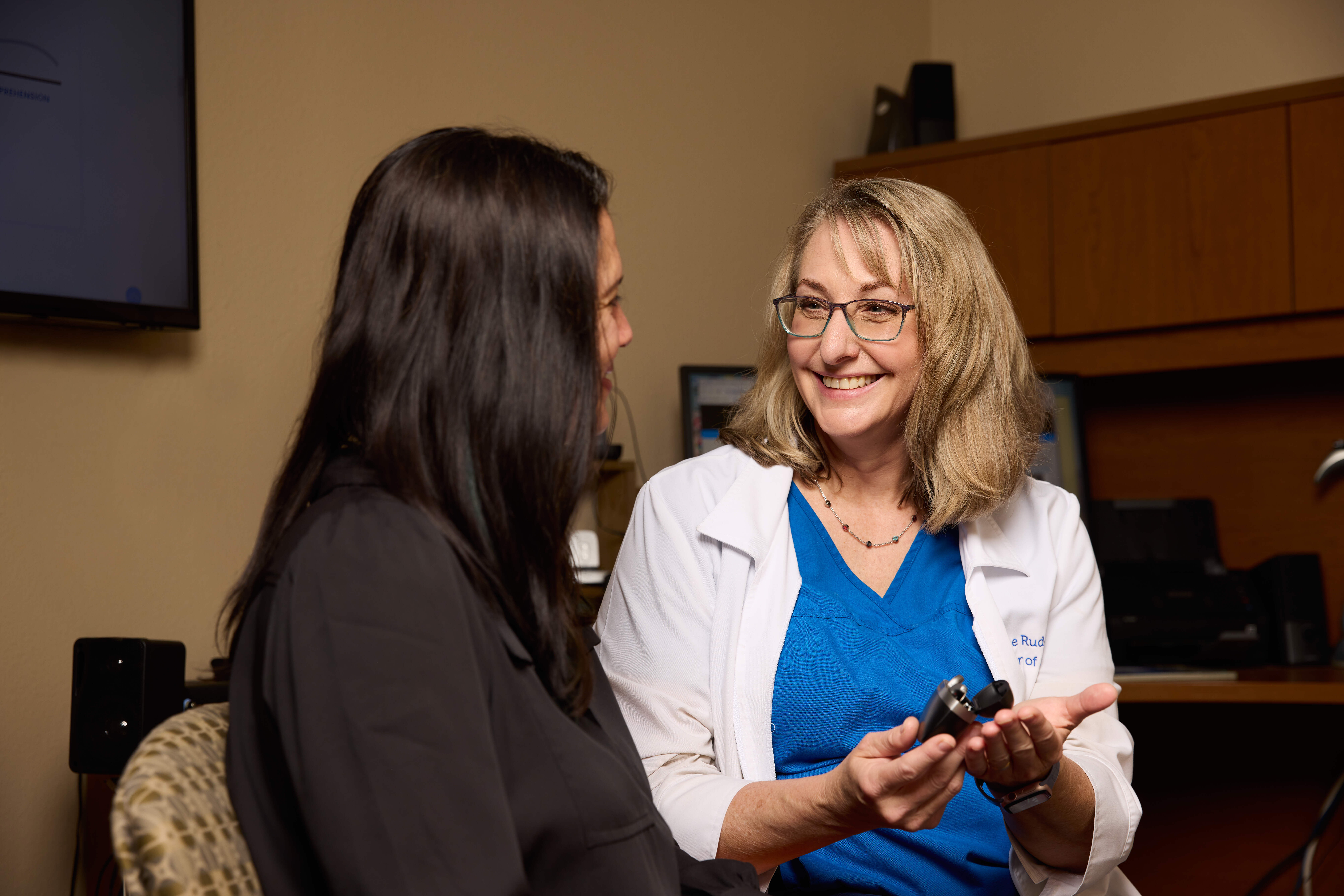
Step 10 - Medical Decision Points and Referrals
(0:50–0:52)

Where applicable, we’ll determine whether your hearing assessment findings suggest routine monitoring or medical workup.

If appropriate, referral language is coordinated for ENT or primary care providers, most likely if findings include:

·       Sudden or rapidly progressive loss 

·       Significant asymmetry 

·       Unilateral tinnitus with asymmetry 

·       Conductive components needing medical management 

·       Concerning otoscopy findings 

·       Significant dizziness/neurologic symptoms 

Hearing care is healthcare, and your hearing affects a lot more than just your ears. As healthcare professionals, it’s our job to know when to treat, monitor, or refer you for further care.

Step 10 - Medical Decision Points and Referrals
(0:50–0:52)

Where applicable, we’ll determine whether your hearing assessment findings suggest routine monitoring or medical workup.

If appropriate, referral language is coordinated for ENT or primary care providers, most likely if findings include:

·       Sudden or rapidly progressive loss 

·       Significant asymmetry 

·       Unilateral tinnitus with asymmetry 

·       Conductive components needing medical management 

·       Concerning otoscopy findings 

·       Significant dizziness/neurologic symptoms 

Hearing care is healthcare, and your hearing affects a lot more than just your ears. As healthcare professionals, it’s our job to know when to treat, monitor, or refer you for further care.

Two women are engaged in a conversation, smiling and sitting in a casual setting.

Step 11 - Your Personalized Treatment Plan: Options, Not Pressure
(0:52-0:60)

You’ll be presented with a prioritized plan of choices for your hearing optimization journey, typically including:

·       Monitoring schedule (if hearing is normal or stable) 

·       Hearing aid candidacy (if appropriate) 

·       Assistive technology and accessories 

·       Communication strategies for family and work 

·       Hearing conservation plan (custom protection where relevant) 

·       Tinnitus evaluation and management support options (if relevant) 

·       Cochlear implant candidacy discussion (when hearing aids may not be enough) 

You leave our clinic with a road map of where you can go for your hearing health, not a sales pitch or devices where you might not need them at all. The right next step depends on your unique needs, both in your hearing health and your busy lifestyle.

Our team acts as your GPS, offering direction and guidance as you drive your journey forward.

Step 12 — Documentation and Deliverables (delivered to you for your records and your physician via email/fax)

You’ll be provided with a clear summary of your results and recommendations (paper and/or digital, depending on your preferences).

If needed, you’ll also get a physician-facing summary of your results in language for medical coordination and a follow-up plan with timelines for annual hearing assessments, hearing aid fittings, or another type of appointment as needed.

You deserve to understand your hearing assessment in language that’s useful, shareable, and easy to understand. You can rest assured that you’ll receive actionable guidance in accessible language for your unique needs.

Step 12 — Documentation and Deliverables (delivered to you for your records and your physician via email/fax)

You’ll be provided with a clear summary of your results and recommendations (paper and/or digital, depending on your preferences).

If needed, you’ll also get a physician-facing summary of your results in language for medical coordination and a follow-up plan with timelines for annual hearing assessments, hearing aid fittings, or another type of appointment as needed.

You deserve to understand your hearing assessment in language that’s useful, shareable, and easy to understand. You can rest assured that you’ll receive actionable guidance in accessible language for your unique needs.

What Makes a Hearing Evaluation at Longmont Hearing & Tinnitus Center Different? 

We start with your story, not the equipment. 

Your story is the starting point, not the equipment. Diagnostic testing is performed—not just a simple screening—and includes speech understanding, ear pressure assessments, and otoscopy. This gives you a full understanding of your hearing health, not just whether you hear a beep or two.

Results are cross-checked for accuracy and reliability, and your ear health is assessed for utmost clarity.

You can rest assured that our team focuses on long-term hearing health, not one-time transactions or sales quotas. You’re provided with an interpretation of your results, counseling, and a written plan for the best clarity and understanding of your hearing health.

 Not all hearing loss challenges are the same, so your hearing assessment should be tailor-made to fit your specific needs, no one else’s.

OPTIONAL ADD-ONS  

Your needs and concerns may involve more than just hearing – this is where your evaluation becomes unmistakably “you.” 

If dizziness is a primary concern: 

·       Targeted dizziness case history + triage 

·       Referral pathway and coordination language

If tinnitus is also a primary concern: 

·       Comprehensive tinnitus intake + impact screenings (awareness, disturbance, sleep, stress link) 

·       Baseline tinnitus questionnaires and counseling framework 

·       Sound tolerance considerations 

·       Next-step tinnitus plan (more in-depth testing procedures beyond a standard hearing test, education, sound enrichment, therapy options) 

If you suspect hearing aids may not be enough: 

·       Candidacy conversation for cochlear implants 

·       Next-step referral/testing plan 

Patient Reviews

Longmont Hearing & Tinnitus Center

Dr. Rudden and her staff have been meeting my hearing needs for well over 10 yrs. , from testing to providing appropriate options for me to make decisions. I cannot praise her and her staff high enough. They are always professional, caring and determined to meet my hearing needs.

Jay

Earles

Why Choose Longmont Hearing and Tinnitus Center for Your Hearing Needs?

Expert Audiologists

With a team renowned for redefining audiological best practices, you can trust that you are receiving the highest standard of care.

Patient-Centered Approach

Every step of our assessment process is designed to put you first - ensuring decisions are made with your comfort & confidence in mind.

Community-Focused Care

As an independent family-owned practice, we prioritize relationships and community engagement, to support you & the community in achieving better communication and quality of life.

  • Exceptional, caring service from everyone that I worked with. I wish I could use more gold stars!!

    Google logo with stylized letters "G" in blue, red, yellow, and green colors on a transparent background.
    John H

    1 day ago

  • This was my first time and I had an excellent visit. All the staff are friendly, knowledgeable and professional and they have high end testing gear. I already rebooked for next year.

    Google logo with stylized letters "G" in blue, red, yellow, and green colors on a transparent background.
    Peter B

    3 weeks ago

  • HUGELY, hugely helpful and very kind. My sister (from the UK) visited Longmont Hearing & Tinnitus Center in January 2025 as she was experiencing significant issues with her hearing aids acquired and programmed in the UK.

    Google logo with stylized letters "G" in blue, red, yellow, and green colors on a transparent background.
    Deirdre B

    3 weeks ago

  • This was my first visit, and I wasn't sure what to expect. As soon as I met Dr. Rudden, I felt completely at ease. She is a caring, warm professional, and I have every confidence that my hearing will improve under her care.

    Google logo with stylized letters "G" in blue, red, yellow, and green colors on a transparent background.
    Susan C

    1 month ago

  • I highly recommend Longmont Hearing & Tinnitus Center, they have been nothing but great since I started going there for my annual hearing evaluations. Jill was very caring and thorough when explaining the results. The entire team provides great service especially when needed the most.

    Google logo with stylized letters "G" in blue, red, yellow, and green colors on a transparent background.
    Alicia p

    1 month ago

Take the First Step Towards Better Hearing

Your hearing health is integral to living fully and engaging with the world around you. Start your journey to improved hearing today with a Comprehensive Hearing Assessment at Longmont Hearing and Tinnitus Center.

It’s often the little things that keep us from moving forward.  If you have a question or concern about your hearing—or a loved one’s—and want a no-obligation conversation with a trusted team of hearing care professionals, help is just a step away. 

Contact us to schedule your appointment and take the first step towards a clearer tomorrow.

Simply fill out the form, and a friendly team member will call you shortly to answer your questions and provide expert advice. 

A person with long hair speaks on the phone in a cozy office setting. A wall sign is visible in the background.
Call Now